Pages

Tuesday, 7 January 2014

Nvidia Unveils Kepler-Based Tegra K1 with 192 CUDA Cores and Optional 64-Bit Denver Processor!

We’ve been talking a lot about Android-powered gaming devices recently. Heck, we even gave them a place here on the XDA forums not too long ago. All of this is possible thanks to the increasingly powerful Systems-on-a-Chip in modern Android-powered devices. Now, Nvidia wishes to up the ante in the low-power SoC world with its Kepler-based Tegra K1 SoC.

New Lineage

The K1 breaks away from previous Tegra devices by merging Nvidia’s GeForce architecture with its mobile architecture. The company accomplishes this by making the K1 (previously codenamed Project Logan) the first mobile chip based on their Kepler architecture rather than the previous GeForce ULP.
For those who have been keeping up with the desktop GPU world, the Nvidia GeForce GTX 600-series marked the introduction of the Kepler architecture, which brought many key improvements over the previous Fermi SM (Streaming Multiprocessor) architecture. Fermi, which was featured in the GTX 400- and 500-series products was widely ridiculed for its power consumption and heat output. The Kepler SMX (Next Generation Streaming Multiprocessor) architecture, on the other hand, was redesigned from the ground up to provide much increased energy efficiency through the use of a unified clock.

192 Cuda Cores

Just like its desktop counterpart, the Kepler SMX in the Tegra K1 features 192 Cuda Cores per SMX unit. And since there is only one SMX in the K1, this equates to 192 total Cuda Cores. This is both a marked increase from the current Tegra 4 (initially featured in the Nvidia Shield), which features 72 cores, as well as the Fermi SM, which offers 32 Cuda Cores per SM unit. All of these increased parallel shader units equate to increased shader and compute power, which can be harnessed with greater gaming visuals.
Below is an Nvidia tech demo showing what these 192 cores are capable of:

Unreal Engine 4

And speaking of harnessing the increased power, it’s certainly not going to waste. Nvidia chose to demonstrate the power of their Tegra K1 using Unreal Engine 4 by Epic Games..

Two CPU Options

In addition to raising the bar on the mobile GPU front, the Tegra K1 brings interesting choices when it comes to its CPU component. Initially, the K1 will only be available with a quad-core ARM Cortex A15, using Nvidia’s patented 4-Plus-1 architecture that offers a low power core for light loads. Eventually, however, Nvidia will release another version of the Tegra K1 with Nvidia’s dual-core Denver CPU. This second version will be based on ARM’s 64-bit V8 instruction set.
The initial quad-core ARM Cortex A15 version is compatible with the 32-bit ARMv7 instruction set. It is a 3-way superscalar architecture, and it will run at up to 2.3 GHz and feature two banks of 32 KB L1 cache. The dual-core Denver variant is compatible with the 64-bit ARMv8 instruction set. It is based on a 7-way superscalar architecture, and it will run at up to 2.5 GHz and feature 64 KB + 128 KB of L1 cache.
Most interestingly, these two versions will be pin-compatible. This means that OEMs will be able to easily switch between the two SoCs and offer different versions of their products for different markets. Thanks to the economies of scale that this allows for, we could possibly see this translate to lower overall costs—or higher profit margins, depending on how cynical you are.

2014 Release.http://www.youtube.com/embed/miEglxHz1iA

So when will all of this be available? There’s no firm release date, and when these chips make their way to actual devices is anybody’s guess, but the quad-core Cortex A15 version will be available some time in the first half of 2014. The dual-core 64-bit Denver version will make its debut in the second half of the year.

The Future of Mobile Gaming?

Are you excited for the future of mobile gaming made possible by the next generation of mobile SoCs like the Tegra K1? From what we can see today, it seems like the bar has clearly been raised, and it’ll be exciting to see how Qualcomm and Samsung respond with the next generations of their Snapdragon and Exynos lines.
More information on the K1 and some basic specs can be found on Nvidia’s own site and Tegra K1 press release. There, you can also learn more about UE4 on the Tegra K1, including a video that we have posted above. And if you want to look at some of Nvidia’s strange ideas for marketing, head over here and watch the video below.

Get Rid of Bloatware on the Nexus 5 with Ease

Get Rid of Bloatware on the Nexus 5 with EaseIt goes without saying that the Google Nexus 5 is one popular device here on at XDA. And given the specs and price point, there’s little reason to doubt why. It’s got some top notch internals, a good build quality, and it is very welcoming to open-source and community development. What the Nexus 5 isn’t exempt from, however, is the great number of bloatware apps that parasitically come alongside the device. A quick and clean fix to purge your device of these unwanted apps comes in simple script form, and XDA Senior Member MoJo has written one for the popular Nexus 5.
As of right now, the script removes 24 bloatware apps, but MoJo does explain further into the thread just how exactly one can customize the script by adding and removing apps if one chooses to do so. Also, if there’s an app listed in the script that’s not actually installed on your device, the script will just skip the app with no consequences.
Two zip files are provided in the forum post: one is intended to work with the Nexus 5, while the second package should work with any device with a custom recovery. To run the script, just simply flash the zip file through a custom recovery such as CWM or TWRP.
So if you’re sick of the bloatware on your Nexus 5, visit the original thread for more information and download.

Tweak the Adaptive Brightness on Your Windows 8 Device

Automatically adjusting the screen brightness depending on ambient light levels, also known as adaptive brightness, is a pretty standard feature on modern smartphones, tablets, PCs, and anything in between. This is most definitely the case for Windows 8 and RT devices such as the Microsoft Surface RT and Pro (check out the review here), Asus t100, and the Dell Venue 8 and 11 Pro tablets. But if you’ve been having issues with the pre-determined screen brightness levels of your Windows 8 device, or you’re simply not satisfied with them, there’s a fix that may help you out.
Developed by XDA Forum Member antys86, this tweak rids you of the default setting that only offers three brightness levels. As a replacement, it introduces a more flexible brightness adjustment that adapts to any light condition. The adaptive brightness changes according to the brightness level you’ve manually set, which means if the level is set at 0, there will be no automatic adjustment in brightness.
Additionally, the tweak shortens the time between adaptive brightness changes from three seconds to only 0.1 second (100 milliseconds). This will not drain the battery faster, as the tweak does not interfere with the sensor refresh rate. Rather, it simply modifies the time between changes in brightness.
This fix is easy to install, requiring you to simply download the provided registry key, run and confirm it, and reboot your device. But as always, make sure to backup your original registry key just in case you want to revert back to the original settings.
If you would like to learn more about this adaptive brightness tweak for Windows 8 and RT devices, visit the original thread for more information and download.

Wearables Dominate the Pre-Event Days of CES

International CES 2014 has begun, we’ve talked about Nvidia’s exciting announcement and the entrance of Android into automobiles, but there is a bigger overarching trend when it comes to mobile devices. That trend is wearables.
Wearables are not new. We’ve had them for a while—everything from the Pebble smartwatch to the Sony Smartwatches, and even Google Glass. However this year, wearables are blending and merging in their functions.
LG_LIFEBAND_TOUCH
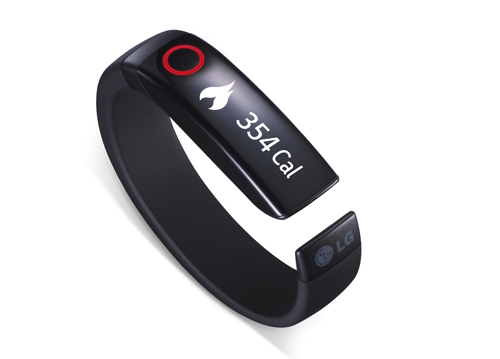
Early Monday morning, LG announced a product they are calling the Lifeband Touch. The LG Lifeband Touch is a hybrid between a smartwatch and a fitness monitor. It does all the things we have come to know and love about smartwatches: display time, biometrics, incoming calls, and music controls all on a touch OLED panel. But it adds in functionality of a fitness monitor. The built-in 3-axis accelerometer and altimeter allows the device to accurately measure key performance indicators such as distance, speed, number of steps, calories consumed, and projected pace. The benefit of this is you don’t have to have two devices clipped to you.
Sony-SmartWear-removable-core
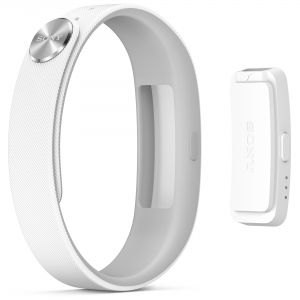
Later in the day, Japanese powerhouse Sony unveiled their take on the quantified self. They introduced the smartwear line of products centered on what Sony has dubbed “the core.” This small fitbit-like device takes care of all the monitoring we have come to expect of fitness monitors. This core devices fits into the Sony SmartBand, with is a wristband that snugly hugs the device. The Sony smartwear line of products tries to expand on the standard physical measurement and integrates in the social aspects of your life. It marks whenever you take a photo and other dubious items like “telling you when you have a good morning,” but not elaborating on what that means.
Pulsense Watch_03
A shocking entry into wearables is printer and projector maker Epson, and they’ve entered the wearable market with a splash. They too have fitness monitors. Epson’s line of products features a breakthrough Epson proprietary heart-rate sensing module that is both accurate and compact and does not require a chest strap. This allows people who are doing aerobics like exercise to stay “in the zone.” This item is another wristband and is called Pulsense.
bt200_01
Finally, Epson takes on Google Glass with glasses that project heads up displays right into your field of vision. Editor-in-Chief Will Verduzco, already talked at length about this so check out his article to find out more.
Of course these are not the only companies making wearables, Pebble released a new smartwatch, a company called fitbug is taking on fitbit in its home turf, and there are many more. And thankfully most of these devices have associated Android apps. In the past, they always released with an iOS app with Android “to be released later.” However, most devices are compete with Android right out of the gate.
So it appears that companies at this year’s CES are turning mobile devices into a database for all the information from all our various sensor based bits and bobs attached to our body. No longer do we carry a device—we will wear our devices, and I think I’m OK with that. As a geek, we love knowing how things work. And with these devices quantifying our movements, we can learn to improve ourselves for the greater good. In the future, you will likely wear many of your mobile devices.

Nokia launches Lumia 1320 and Lumia 525 in India

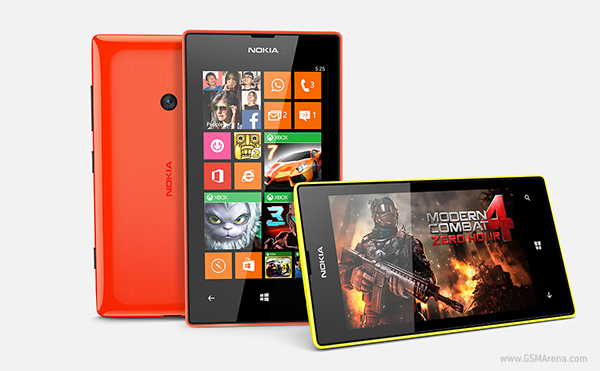
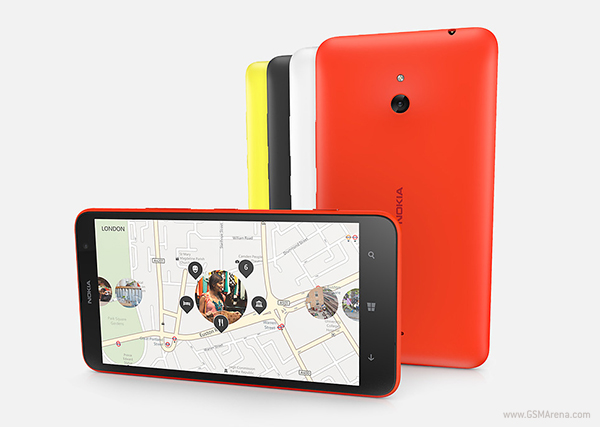
Nokia has launched two new Lumia phones in India. The first is the Lumia 1320, which shortly follows the flagship Lumia 1520 launched last month. The Lumia 1320 is priced at INR 23,999 ($385).
The Lumia 1320 has a 6.0-inch, 1280x720 resolution display, dual-core 1.7GHz dual-core Snapdragon S4 processor, 5 megapixel camera, 1GB RAM, 8GB internal memory and microSD card slot.
The Lumia 525 is more of a budget offering. It is priced at INR 10,399 ($167). It has a 4.0-inch, 800x480 resolution IPS LCD, 5 megapixel camera, dual-core 1GHz Snapdragon S4 processor, 1GB RAM, 8GB internal and memory with microSD card slot. The Lumia 525 also comes with free Gameloft games worth ₹2,025.

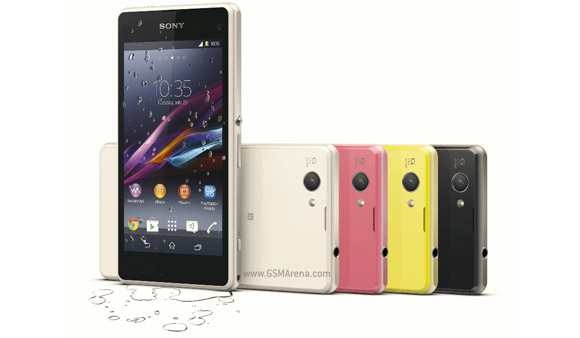
Sony Xperia Z1 Compact goes on pre-order in the UK

The hotly anticipated Sony Xperia Z1 Compact is already drawing attention from carriers and phone stores. A couple of UK-based retailers have chimed in that they've started taking pre-orders.


Phones4u offers the Xperia Z1 Compact on contract with Vodafone, EE, T-Mobile and Orange. The phone itself is free, monthly taxes start at £30. If you pre-order from Phones4u, the retailer will throw in a Sony wireless speaker (SRS-BTX300, valued at £120) and up to £65 in movies and music.
The phone will be delivered on January 31 for those who pre-order today.
If you don't want a contract, Unlocked-mobiles offers the Sony Xperia Z1 Compact on pre-order for £440 (including VAT). The stock will arrive in early February.
All four color options for the Z1 Compact – Black, White, Pink and Lime – are available. We checked other UK-based sites for more offers, but there's nothing yet.

Samsung Galaxy S5 rumored to use Sharp's 2K display

According to a report by Chinese website Tencent, Samsung has decided not to use a Super AMOLED HD display panel for its Galaxy S5 flagship smartphone. Traditionally, ever since the first Galaxy S smartphone, Samsung has always preferred its own AMOLED displays for its flagships.
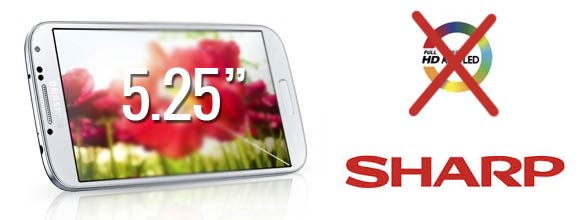
However, according to the report based on unconfirmed information, the Galaxy S5 will be an exception, as Samsung has chosen Sharp to provide a 5.25" 2K Ultra HD LTPS display panel. It's going to pack an exceptional pixel density of 560 pixels per inch.

The reason behind Samsung's decision resides in one of its subsidiaries, which has run into production issues with the 2K Ultra HD AMOLED displays. As a result of them, the company can't keep up the production and won't be able to make enough of them to meet the expected Galaxy S5 demand.
Choosing Sharp will also allow Samsung to free up its display factories for the upcoming flexible line-up of AMOLED displays, which it hopes will reach large market availability by 2015. Additionally, if Sharp really turns out to be the manufacturer of Galaxy S5's displays, this will be beneficial to Samsung, which owns 3% stake in the company back in March.
The report confirms earlier evidence of the Galaxy S5's 2K UHD display, which popped up in a leaked benchmark of the device. Other rumors suggest the Galaxy S5 will be launched (or at least shown) as early as Q1 of this year, have a 16 MP snapper with the ISOCELL tech, perhaps without optical image stabilization and possibly with some elements resistance in tow. That is hard to take in all at once, we know.

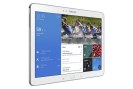
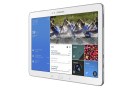
Samsung Galaxy Tab Pro 10.1 unveiled early

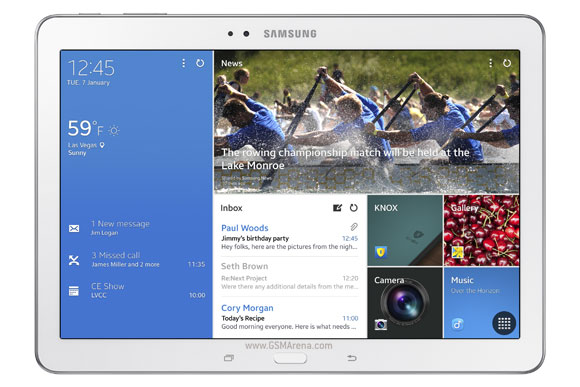
A bit before the event itself, the Samsung Galaxy Tab Pro 10.1 went live on the SamsungMobilePress website. The Android 4.4 KitKat powered tablet is very close to the Galaxy Note 10.1 (2014) in terms of specs, though obviously it lacks the S Pen stylus.


The Samsung Galaxy Tab Pro 10.1 features a 10.1 Super Clear LCD with WQXGA resolution (2,560 x 1,600 pixels) and is powered by either an Exynos 5 Octa or a Snapdragon 800. The tablet will run Android 4.4 KitKat at launch, which is the latest version available and newer than what the Note 10.1 currently has. The RAM is "only" 2GB instead of 3GB as on the Note, however.

Samsung Galaxy Tab Pro 10.1 official photos

Anyway, tablet uses the same camera setup – 2MP front facing camera and an 8MP camera on the back. The S800 model can record 1080p @ 60fps videos with the back camera, while the Exynos tops out at 30fps.
Another limitation of the Exynos model is that it is Wi-Fi + 3G only, while the Snapdragon model has LTE connectivity too. Both feature Wi-Fi 802.11 a/b/g/n/ac with channel bonding, Bluetooth 4.0 and USB 2.0.
Both tablets also feature GPS + GLONASS, an IR blaster and 16GB or 32GB built-in storage, expandable with microSD cards.

Samsung Galaxy Tab Pro 10.1 official photos

The Samsung Galaxy Tab Pro 10.1 features an 8,220mAh battery (same capacity as the Note 10.1) and measures 243.1 X 171.4 X 7.3mm. The LTE version weighs 477g, while the other is a bit lighter at 469g.
The page has been pulled since (here's a screenshot we took before it was taken down). We expect it will go back up once the tablet is officially announced. By the way, according to rumors we're waiting for Note Pro tablets too.

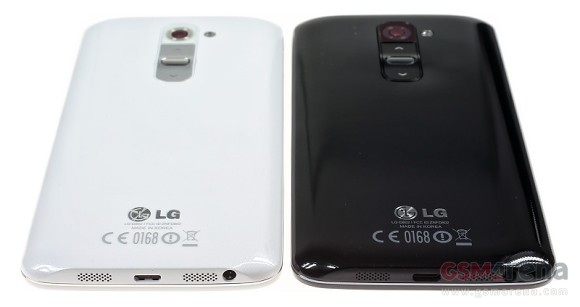
LG reportedly sold three million G2 smartphones

According to a report in Yonhap News quoting local analysts, LG has sold three million G2 smartphones globally since the device's launch. The latest sales number is higher than the previously reported two million units sold by the Korean manufacturer.

One million LG G2 units were sold between August and September - hot on the heels of the flagship's New York City launch. The remaining two million devices got into customers' hands in the last quarter of this year. Out of the three million units, 900,000 are said to be sold in LG's home market in South Korea.
While three million units is undoubtedly a stellar sales number, LG still has a way to go before it reaches its targets for the G2. Back in September, LG announced its intentions to sell 10 million G2 units.

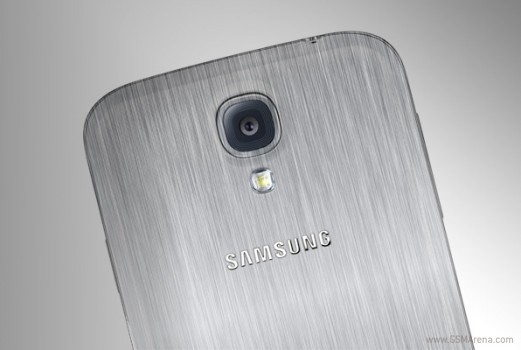
Samsung launching metal Galaxy F along with S5

Do you love your Galaxy S4, but are envious of the HTC One's aluminum body? Well you're in luck, because Korean outlet, ETNews reported that Samsung plans to make a high end metal smartphone: the Galaxy F. The phone will be decked out with a metal exterior, and should be launched around the same time as the highly awaited Galaxy S5.
This is supported by earlier reports that a production line in Vietnam was created for making metal casings for the Galaxy S5. Samsung had plans for a metal clad, premium line of smartphones, which will carry the model number SM-G900F, giving more and more credence to the phone's rumored release.


The Galaxy F is purported to be Samsung's newest top-of-the line handset, but we don't know if this "premium" approach extends to the device's technical specs. There's been rumors that in addition to the metal body of the Galaxy F, the phone will sport an awe inspiring QHD 2K display (2,560x1,600 pixels). However, these rumors are unsubstantiated. We will keep you up to date with any further developments on the Galaxy F.

HTC M8 rumored to be called One+

Although it may not be the most original of names, HTC's newest flagship phone is rumored to be called the One+.
Evleaks released details about HTC's M8 yesterday: namely that it will have a 4.9 inch Full HD display and a Snapdragon 800 processor under the hood. However, popular XDA member, Mike1986, indicates that the M8 is indeed the One+, and has a list of rumored specs that go into greater detail and suggest that the One+ will be a much better spec'd device than previously thought.


The One+, according to Mike1986, will have a 5-inch Full HD Gorilla Glass 3 display, a Qualcomm Snapdragon 805 processor, 2GB LPDDR3 RAM, a 6MP or 8MP camera with double lens (rumored to be exchangeable), a 2.1MP front camera, 2,900 mAh battery, a microSD card slot and NFC.
On the software side, we can expect the One+ to have Android 4.4 Kit-Kat out of the box, overlaid with HTC Sense 6. Another interesting fact is that the One+ is rumored to not have any physical buttons, with all of the Android interaction taking place on screen, a la the Nexus 4 & 5.
As always, these are just rumors, so don't take them as gospel just yet. The One+ is speculated to make its debut at Mobile World Congress, from February 24-27 in Barcelona.

Beats sale helps HTC turn to profit in Q4

HTC posted its Q4 report and the numbers are worse than expected with the company’s struggles in the market continuing. The Taiwanese recorded a second successive quarter of operating loss, bleeding $52 million through its core business.
However, the sale of its stake in Beats, helped bring the bottom number in the black. Net profit stood at $10 million, which is better than the $99.9 million lost in the previous quarter, but short of analyst estimates of $24.3 million in profit. The number is also significantly lower than it was in Q4 of 2012 - $34 million.


Even more alarmingly, revenues continue to slide down, suggesting that HTC continues to lose market share. The company manage to bring in only $1.43 billion, compared to $1.6 billion in the previous quarter.
A drop in sale during the holiday quarter, when demand for mobile phones is a clear indication that HTC’s 2013 lineup hasn’t lived up to the market expectations. The company will have to work hard to turn things around in 2014, but we really hope it succeeds and gets back in the game.